Deceit in the Dark

Deceit in the Dark

By Sara Codair

The vampiress hissed. “Mortal fool! Challenging me will be your doom!”

The knight arched one eyebrow. “Perhaps it will be your doom.”

She screeched, hoping to intimidate him. Her most terrifying, earsplitting howl failed to impress the knight. His eyes and skin were like ice and snow. His was hair weak sunlight glistening on the polar ice. He still had that damned eyebrow raised. It was so unfair that he could arch his right brow so perfectly. She had been practicing for three centuries and had never mastered the trick.

“You’re a fool, challenging me at night in my own castle. Every man and woman who has tried before you became my breakfast.”

The knight laughed.

She rolled her eyes.

A sharp pain pierced her chest. It was the first pain she had felt since Count Dracul had turned her on her 18th birthday. Looking down, she marveled at the iron stake sticking out of her chest. She watched her skin shrivel and turn to ash. She clung to consciousness long enough to see the knight peel off flesh colored gloves, revealing the green skin of a pixie.

“Green bastard!” she yelled. She never would have rolled her eyes if she knew he wasn’t a slow mortal.

“New technology. It lets us blend in with humans and not be burned by iron.”

Count Victoria wanted to curse him one last time, but her throat was already gone.

His blonde hair turned coal black; his face grass green. “I’m no mortal, and certainly no fool.”

The rot and ash reached the vampiress’ brain, and she was no more.

The End.

©2016 Sara Codair

This story was originally posted on Cracked Flash as an entry for their weekly writing contest. It was the week’s honorable mention.  The judge, Mars, suggested I remove the first few lines, and really, she was right. The originally piece started with the line “But the night belongs to me.” I either needed to add more dialogue before or just cut it, and since anything I could think to add would be boring, the first few lines went bye bye, making the piece shorter and catchier (at least in my opinion).




Faith in Eternal Stars – by SARA CODAIR

Star Wars has survived the apocalypse. So has its rival, Star Trek. Find out how in this survivor’s tale that was just published by Sick Lit Magazine.

  Faith in Eternal Stars   We said, “Save the world or die trying.” Most of us did the latter. Things like extinction or total annihilation were never certain. We just knew the demonic al…

Source: Faith in Eternal Stars – by SARA CODAIR

Faith in Eternal Stars – by SARA CODAIR

Star Wars has survived the apocalypse. So has its rival, Star Trek. Find out how in this survivor’s tale that was just published by Sick Lit Magazine.

sicklitmag's avatarSICK LIT MAGAZINE

Faith in Eternal Stars

We said, “Save the world or die trying.”

Most of us did the latter.

Things like extinction or total annihilation were never certain. We just knew the demonic alliance used their fire and magic with no regard for the destruction they caused.

We tried to preserve the earth. She was our mother. We couldn’t bear to harm her, even in her own defense.

They won. We lost.

For a long time, I thought I’d died and gone to Hell. I floated in cold darkness, never quite awake, but never fully asleep. I couldn’t get warm. I couldn’t move. I couldn’t scream.

The Christians had said Hell was hot, but I’d fought too many ice-demons to believe it was all fire and brimstone. Even as I floated in stasis, I wondered, if this was Hell, where were all the demons? Had they all abandoned their home realm…

View original post 799 more words

Short Stories Reviewed

I’ve seen plenty of blogs and websites that review longer works and movies, but I was pleasantly surprised when I stumbled across a website called “The Short Tale Review.”

At first, I thought they were a literary magazine specializing in flash fiction, but I quickly realized they published short reviews of short stories. They featured classics, like Shirley Jackson’s “The Lottery,” as well as brand new works by contemporary authors.

When I saw they were accepting submissions, I emailed them asking for a review of one of my stories, and a few days later, they posted a review of Beach Glass Blues.

Here is a brief excerpt:

“As an ‘adult’ story about the world of mermaids, mermen and merfolk this could be, let’s be quite honest, a bit silly and childish in the wrong hands. Even more so when used as a device to question sexual politics. Thankfully Sara Codair is an adept enough storyteller to navigate us through these potential pitfalls.”

Read the rest here and don’t forget to check out some of their other reviews.

Their sight is a great way to promote and give the often overlooked short story authors a taste of the kind of attention they might get if they were publishing novels.

Published by Foliate Oak

Today I had a piece of flash fiction published by Foliate Oak Magazine:

“You open the closet on Monday morning, trying to decide what to wear. His side: everything is ironed, organized by color and meticulously hung. Your side: wrinkled shirts cling to hangers and sleeves dangle dangerously close to the floor.”

Read more here.

Finals Week and Chicken Soup

As the semester comes to an end, it can be hard to remember to eat at all, let alone eat healthy. This was true for me when I was a student, and still is true now that I am a teacher. Since women cannot survive on chocolate alone (though we often want to), I believe it is critical to make sure that I do not let the stress get to me.

No matter how chaotic it gets, I need to eat and I need to take time to make sure I don’t burn out. Writing, cooking and taking pictures are often therapeutic for me, so before I dive into the grading this morning, I am taking some time to make food and a blog post.

Friday night, I was too tired to do much cooking, so my husband picked up a rotisserie chicken from a local grocery story, and I boiled some Jasmin rice.  We barely ate half the chicken, so I decided to save to rest for soup.

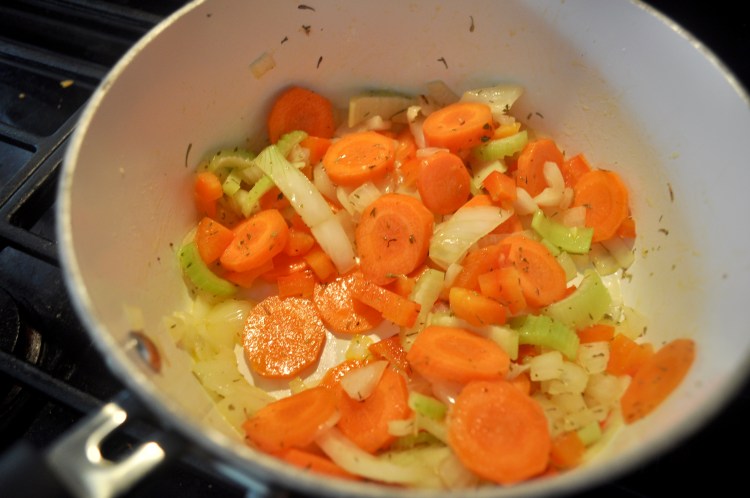
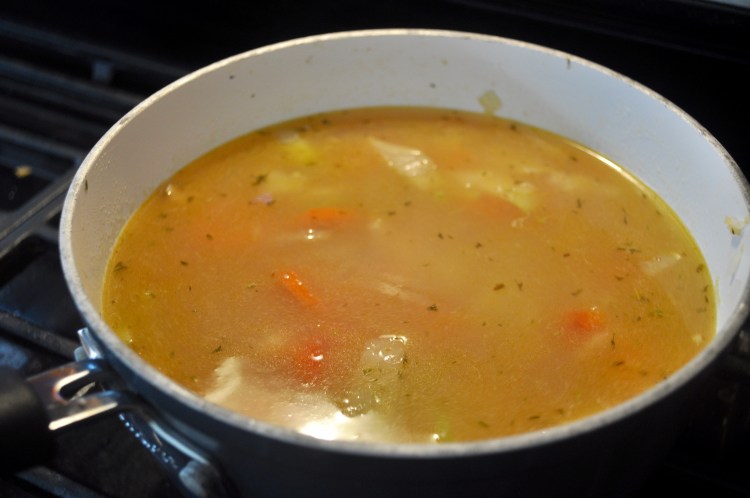
I started with vegetables:  Half a large onion, a quarter of a bell pepper, one large carrot and one stick of celery. I cut them up and sautéed them with olive oil, thyme and parsley.

DSC_0903

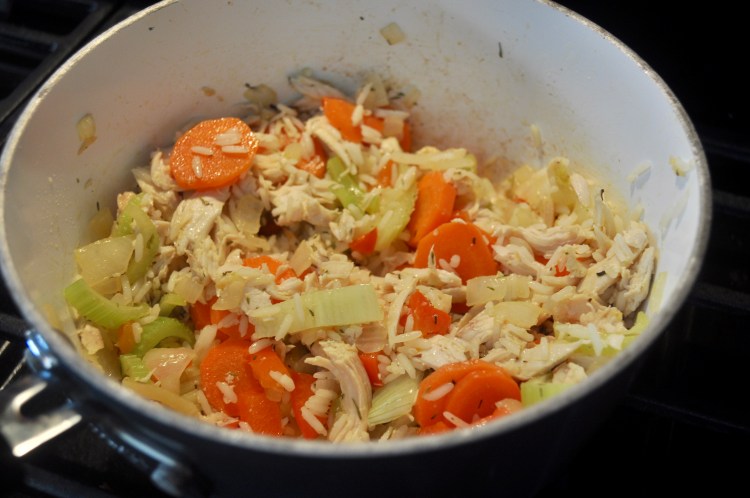
Next, I added the left over Rotisserie Chicken.

DSC_0907

More dedicated and experienced cooks would use the whole thing to make stock, but I have a very limited amount of time allowed for writing and cooking this morning, so I just ripped off some white meat and threw it in the pan. I didn’t use all the leftover meat, so I put it back in the fridge in case my husband (who is a much better cook than me) wants to use it for something.

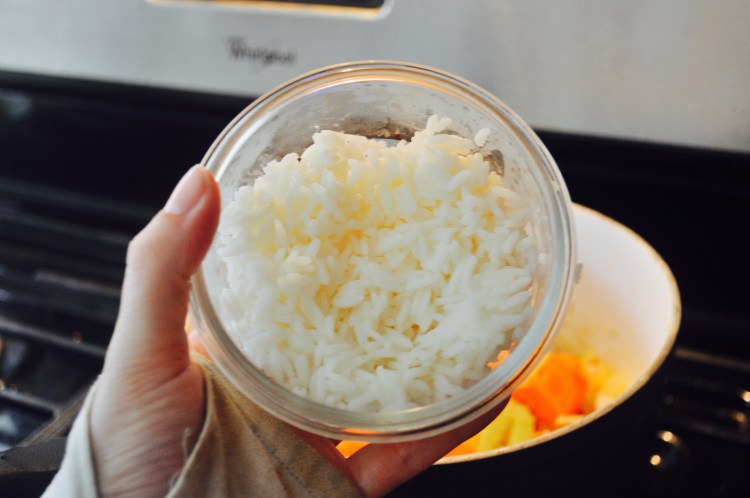
We did have some jasmine rice left over from Friday, maybe a 1/3 cup, so I added that to the pan next.

DSC_0908DSC_0909

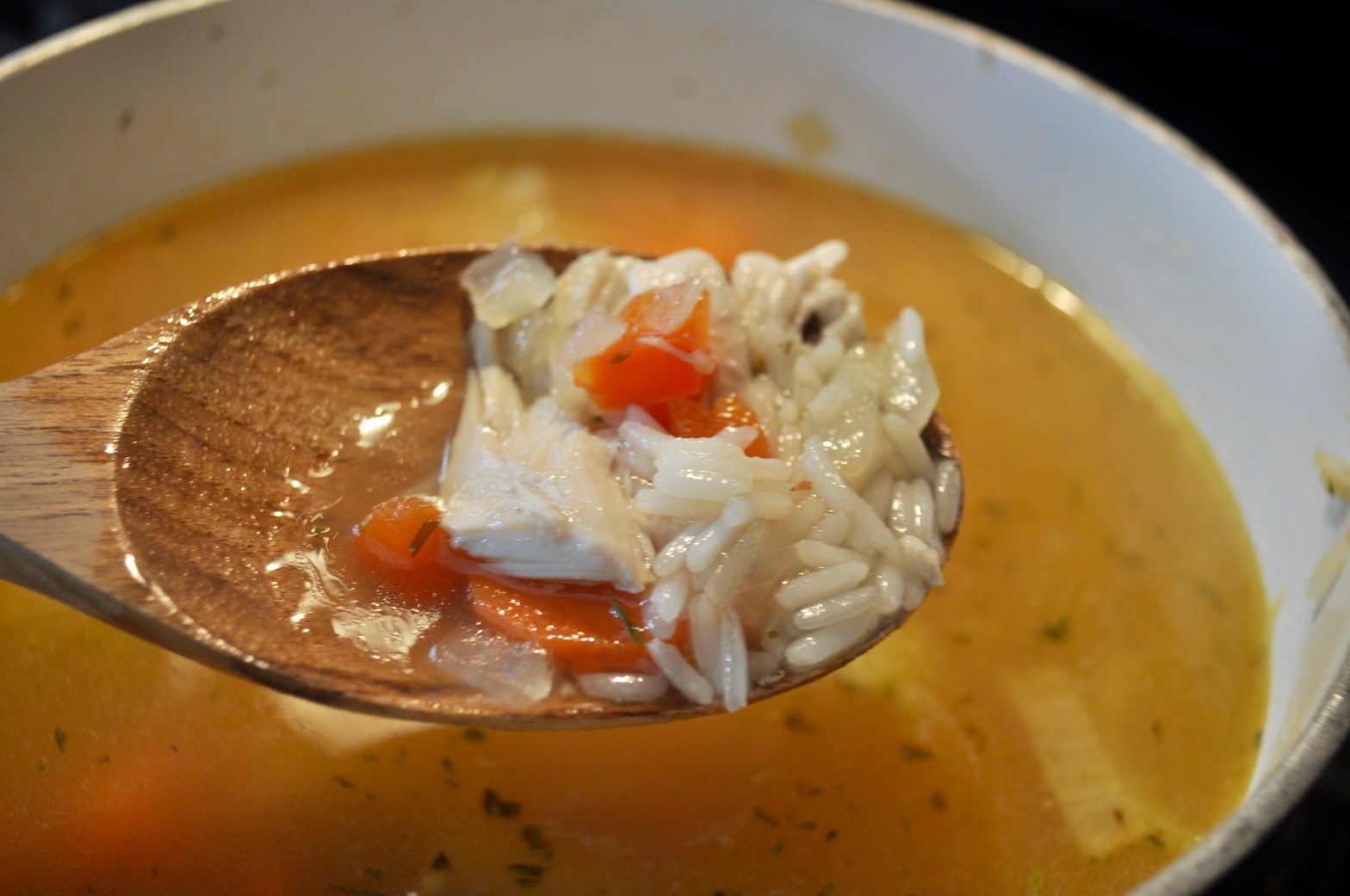
I stirred it, letting it all simmer for a few a minutes, then added a box of organic chicken stock.

DSC_0910

I’ll let it all simmer while I grade. At noon, when I need  a break, I’ll have a bowl of soup, giving my body some veggies, protein and grain to help it power through the next round of papers. I’ll put the left overs in the fridge and take them to work for lunch on Monday and Tuesday, guaranteeing that I will have something healthier than cookies to eat between my classes.

©2016 Sara Codair

The Final


The Final

By Sara Codair

It was too late to turn back–for all of them. The test had begun. They would either collaborate and score at least 75% and become wizards, or fail, get their minds wiped, and live out the rest of their lives in a factory.

Gretchen didn’t want to spend her life as a mindless soap- manufacturing drone, but no one would focus. Unfortunately, collaboration was essential. They each had a different piece of the equation to solve on the Physics of Potency exam. Jack was so busy ignoring Ricardo that he missed an important variable, meaning that by the time Gretchen arrived at her portion, she had to redo his before she could answer hers. Felecia was distracting Pi; he messed up his portion. By the time the answer was put into the crystal proctor ball, it was wrong.

“You’re all idiots,” muttered Gretchen, but no one heard her.

“Just focus on your task,” she shouted, and they still didn’t hear her.

When they got five consecutive questions wrong, she lost it. It was statistically impossible to pass now, but she wasn’t going down without a fight. She’d prove she was a capable mage, one way or another.

Enraged as she was, gathering power was easy. She wrapped it around herself like a flaming cocoon. Equations danced across her eyelids; she solved them effortlessly. The numbers translated to words as she spoke, sending flaming energy out from her fingers to her classmates. It twined around their bodies, contorting their forms and until they were just a herd of baaing goats.

The exam board materialized. They were all grinning.

“That’s a pass if I ever saw one,” said the headmaster. The deans all nodded in agreement.

©2016 Sara Codair

An earlier draft of “The Final” was posted on last week’s Cracked Flash competition. It was the honorable mention, so it received some feedback from the judges, so I made some changes and posted the final version here. You can enter this week’s competition at http://crackedflash.blogspot.com/

The Magic of Tuesday Acceptance Letters

Tuesdays are the best and worst day of my week. I leave the house at 8:30 a.m. and don’t get home until 9:30 p.m. I tutor all day and teach at night, ending the day with my favorite group of students. By the time I get home, I’m exhausted, hungry, and off-the-wall hyper.

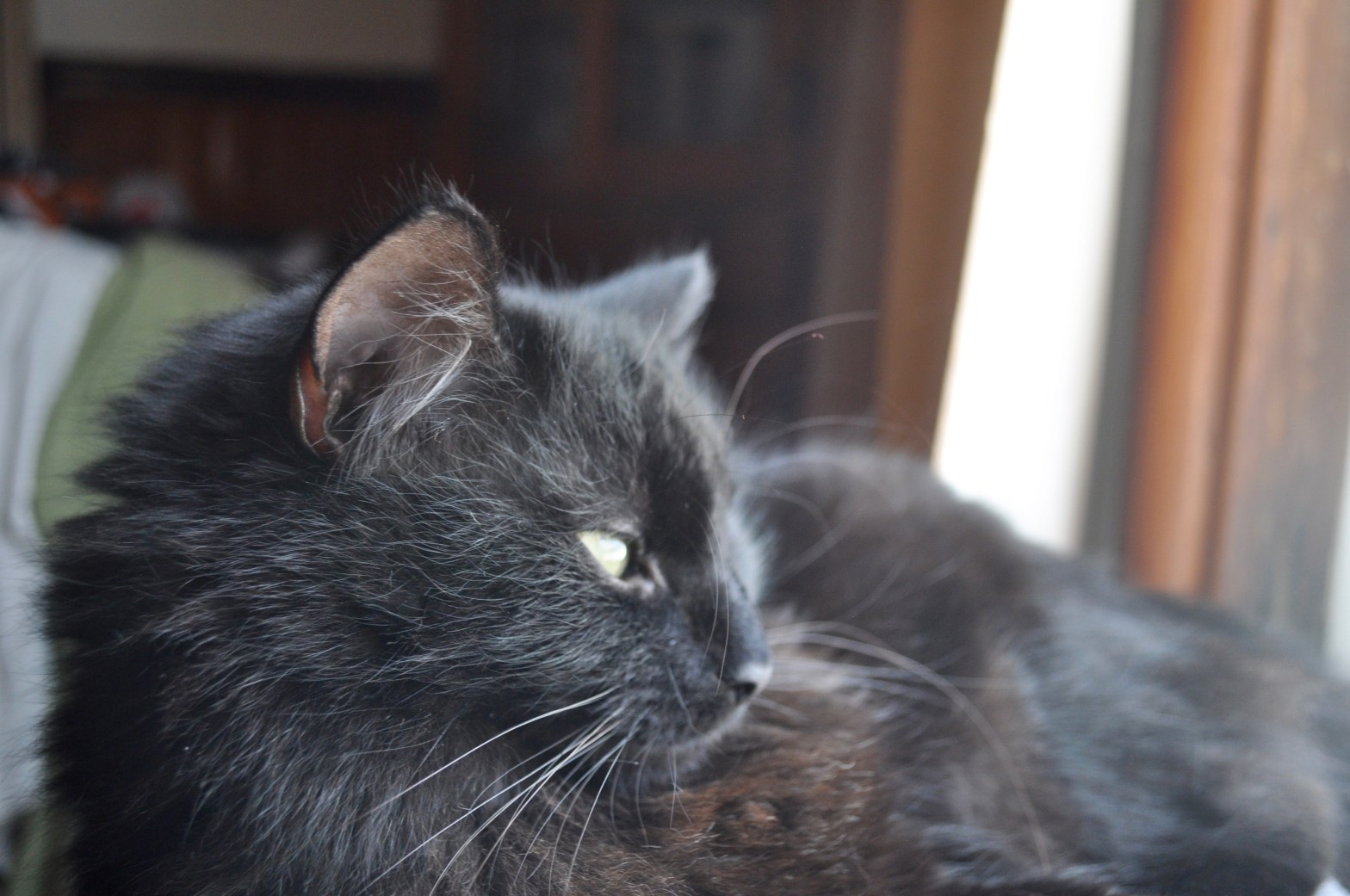
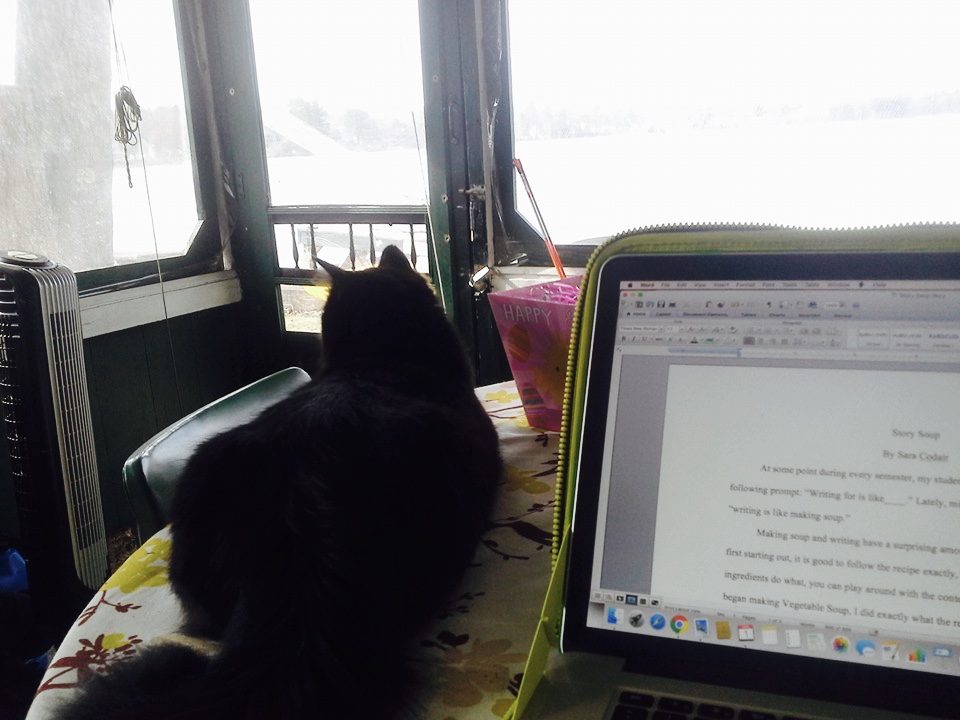
This Tuesday, I got home, made myself a cup of chamomile tea and curled up on the couch to watch This Old House. After watching a foundation poured and inspected, my husband and I found ourselves in a classic millennial situation: sitting out the couch with Mac Books on our laps, focused more on screens than each other. I would have rather had the cat on my lap than my computer, but he was unwilling to grace me with his presence.

I looked up from my screen, watching the cat bat his noisy ball around the living room. Glancing over at my husband, I said, “You know, for the past two Tuesdays, I’ve gotten good writing news.”

“Thats good,” he said lifting his eyes away from Facebook Messenger.

“Two weeks ago, I found out I was a finalist for that contest. Last week, I got a story accepted for an anthology. I didn’t get any rejections today, but there wasn’t any good news either.”

He shrugged. “No rejections is still pretty good.”

Our attention shifted back to our screens. An email notification popped up on mine, informing me I had a new message from Foliate Oak Literary Magazine.

“Crap,” I muttered as I opened the message, expecting a rejection.

Then I jumped out of my seat. “Wait, I just got an acceptance!”

“You spoke to soon,” he said closing his lap top.

After a doing a proper happy dance and playing the the cat, I took my laptop to the kitchen table to withdraw the story from the other places I had sent it, update my bio and find a decent photo of myself. I only accomplished two of those three things before I went to bed, but I was happy and confident that there was a point to my obsession with submissions. It was worth all the hard work. I had found a home for another one of my stray stories.

DSC_0793

Write What You Know (or not).

“Write what you know” is a saying I have heard from many different people. I don’t usually agree with it, and find I prefer to use writing as a tool for exploring what I don’t know. The internet and library data bases can tell me almost anything I want to know about any subject. Writing about the unknown is the best way to motivate myself to do research and come to understand the research by writing about it, whether I am incorporating it into a novel, blogging, or writing academic prose.

As much as I like to think of writing as a tool for inquiry, I will not deny that it is easier to write about things I am familiar with. This month, I was reminded of just how big an impact knowledge and confidence can have on a person’s ability to write coherent prose.

There is one student who has been coming into the writing center on and off for a couple years. Lately, I have been tutoring him at least once a week. I’ll call him Bob for the purpose of this post.

Bob is a very good writer, lacking more in confidence than skill. Last week, I was working with him on a beautifully organized essay about business etiquette in his home country. Since English isn’t his first language, he needed help with the grammar, but little else. The essay had a strong voice, specific purpose and clear organization.

Today, he brought me an essay his instructor asked him to revise. To be honest, this essay seemed like a different student wrote it. The ideas were all over the place and some sentences were very difficult to decipher. If I hadn’t been working with him for so long, I might have suspected that the previous essay had been plagiarized.

As our session went on, I came to understand that he knew almost nothing about the topic prior to starting his research. He had been thorough with his research, but his lack of knowledge was having a major impact on his writing. He was disorganized, jumping from one topic to the next before he was done explaining it. There were missing sentences, missing words, and errors with tense and punctuation that I knew he had mastered last year. He was so focused on making sure he got his facts straight in both the writing and revising process, that he failed to organize the paper in a coherent manner and missed dozens of grammatical errors. His level of knowledge really effected what he was capable of.

While its fine for an experience writer to throw rules like “Write what you know” out the window and use writing as a tool for research and discovery, beginning or developing writers do much better when they are familiar with their subject.

It is good to let students write about things they are familiar with and gradually move them into using writing for inquiry.

When writers are taking their first adventures into fiction, they might want to start out by writing stories set in places they’ve been with characters doing things they know a lot about. Once they get a good handle on the craft (organization, detail, plot, structure, character, dialogue and grammatical control), then they can branch out to the unfamiliar.

I love to use writing to explore “what if” scenarios. If I am curious about what it is like to be exist as a hispanic teenager, an overweight man or a trans woman, I read, I watch, and then I write. When I get bored with my world and cease to appreciate it, I make up a new world that is far less comfortable than my own. Through writing, I experience thing that make me appreciate the privileges and comfort of my own life.

I used to just write what I understood. Now, I go out of my way to write what I don’t.

DSC_0042

©2016 Sara Codair

Submission Talk: Multiple Flashes in one Document

Hello followers and fellow writers!

Instead of a traditional post, today I have a question that I hope will propt a discussion in the comments section:

When you come across publications whose guidelines say things like “Send up to three flashes in one document” or send “For flash fiction, please send three pieces, all pasted into one document,” do you usually wait until you have three? or just send one? If you send two or three, do you select pieces that are drastically different from one another? or pieces that are thematically similar? Why?

Have you eve had something accepted from this kind of submissions? If so, so they accept everything or just one story?

For a while I avoided publications that ask this because I didn’t to handle it. However, this week, I got brave and submitted a few documents containing three very different flashes and one with some thematically similar stories.  Anyways, I would love to hear about your experiences!

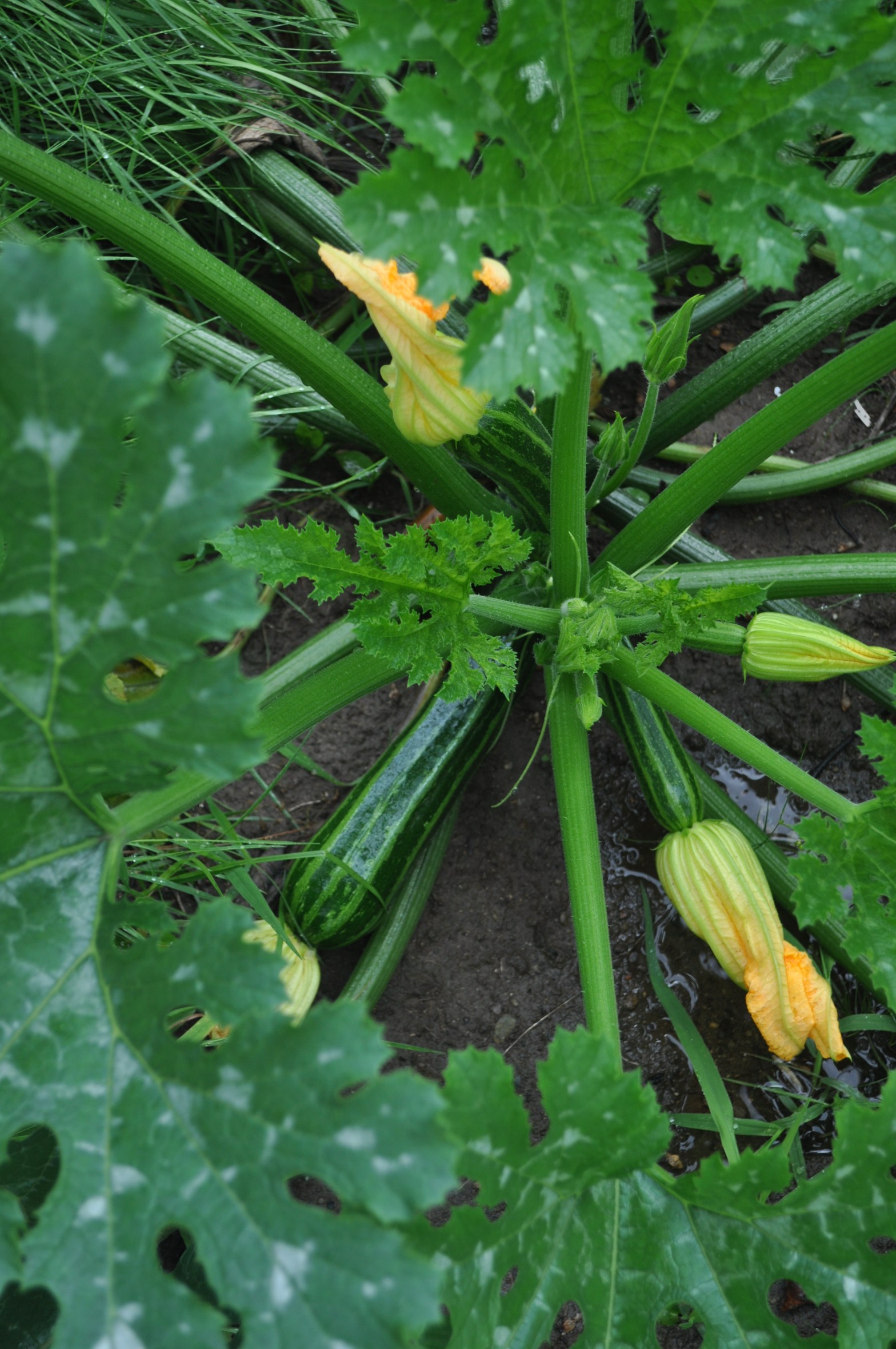
p.s. If you are wondering why there is a picture of zucchini on here, it is because there are multiple fruits growing on the same plant, just like multiple submissions hanging out in one document. Will they motivate the owner to care for the plant and encourage them all to grow? or will they kill each other with competition?