When I fist took this photograph on a cold February day in Portland, I had no idea what it was going to do for me.
When I started selling on Etsy five years ago, I made prints of it and put them in repurposed frames and sold them. Not only did I sell several on Etsy, but I also sold several at local flea markets.
I no longer maintain my shop on Etsy, but these doors are still working for me. In November, my writing group assigned it a prompt where we had to choose an image of a door and tell a story of what was behind it.
For that exercise, I wrote a short story called “Dull Blade.” That turned out to be the second story I had accepted for publication, and the first one to be published that was full length, not flash. I hope you head over http://fantasycrossing.com/ and read it.
Here is a brief excerpt:
José couldn’t make his hands stop shaking. That was a problem. He couldn’t shoot straight when his hands were shaky, and if he missed, the demon on the other side of the door would probably rip his guts out...click for more!
If you ever find yourself lost for words, pull out one of your favorite photos and tell the story behind it.
At some point during every semester, my students and I write in response to the following prompt: “Writing for is like____.” Lately, mine has begun with the words “writing is like making soup.”
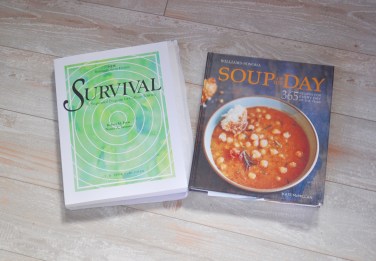
Making soup and writing have a surprising amount in common. When you are first starting out, it is good to follow the recipe exactly, but once you get a feel for which ingredients do what, you can play around with the content and structure. When I first began making Garden Vegetable Soup, I did exactly what the recipe says. The result was edible, but it wasn’t scrumptious. Now, I’ve modified so much that it is not longer recognizable as the recipe I started with from Soup of the DayBy Kate McMilliam, and frankly, I like it much better my way. Other people might find her recipe superior if they have different tastes then me, and that’s fine. Food and writing are both subjective.
I use this metaphor when I tell my students why they need textbooks. The books provide recipes for essays. While the students are still developing as writers, they need to follow the recipes to practice engaging introductions, clear thesis statements and easy to follow patterns of organization. Once they get the basics down, they can change up the ingredients and proportions to tailor their essays to fit their specific needs or assignments.
This concept can also work for fiction writing and poetry. You can learn what makes a story by starting with simple plot structures, and start with structured forms of poetry that provide writers with a set number of lines and syllables. Get the hang of choosing words carefully to create form and meaning. Get the gist of taking a character on an adventure that will leave him or her forever changed, and then go back and break all the rules you just learned to write even better stories, better poems, and make better soups.
I hope you enjoy the following recipe for “Story Soup.” Feel free to make adjustments as you see fit to better match your soup preferences.
Ingredients:
2 tbs olive oil
Fresh veggies from the garden make the best ingredients! Show above are onions, tomatoes, a pepper, a carrot and a potato from last summer.
½ of a Large Sweet Onion or a whole small one.
1/2 Bell Pepper (red, yellow or orange)
1 Large Carrot
1 Stick Celery
1 Potatoes (optional)
Broccoli, Kale or Spinach (optional)
A small summer squash or zucchini
Green beans or snap peas
½ can of corn (or fresh equivalent)
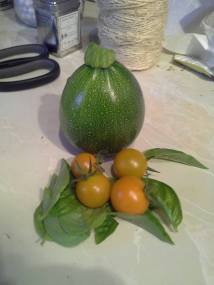
Zucchini ball, Sungolds and Fresh Basil
A handful of sung gold tomatoes
Two large heirloom tomatoes
Your choice of rice of pasta
Thyme
Basil
Salt
Step 1: Pour the olive oil into a large saucepan.
Step 2: Dice the Pepper and Onion, then add to the olive oil. Simmer over medium heat.
Step 3: Cut up the carrots, celery, squash, and beans while the peppers and onions cook. Add potatoes and/or broccoli for a heartier version. Once the onions are translucent, you may begin to add these vegetables.
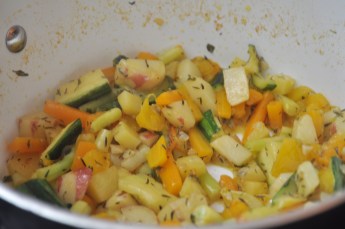
Step 4: Coat the vegetables with approximately one teaspoon of Thyme and Basil. If you used larger veggies, you might want to add a little more. Allow the vegetables to cook until they become tender. The carrots and celery take longer than the other veggies, so I suggest chopping and adding those first.
Step 5: Cut up the Sungolds. Add those and the corn at the same time.
Step 6: While the veggies continue to cook, put the tomatoes into a food processor and puree them. If you prefer chunkier soup, you may dice them instead. Add them to the pot when they are ready.
Step 7: Allow the vegetables and tomatoes to simmer for approximately ten minutes then add one box of vegetable stock or the equivalent of homemade stock. I usually use Pacific Organic.
Step 8: Bring to a boil then add your choice of rice or pasta. Reduce heat immediately.
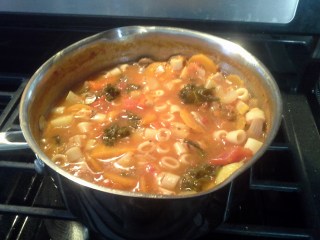
Step 9: Allow it all to simmer for at least one hour, stirring occasionally. The longer you let it cook, the better its tastes. I am often hungry and impatient, so I eat a bowl after an hour but let it cook for two or three more. The next day, when I have seconds, the taste has significantly improved.
Step 10: Put whatever soup is left in the fridge when you are done cooking it.
I write fiction, and I teach. That pretty much sums up my life during the school year. In the summer, I write even more and spend insane amounts of time outside.
Being adjunct can be tough because I have drive a lot and don’t get benefits, but I am fortunate enough to have a part-time tutoring job that adds some stability to the mix.
Furthermore, adjuncting supports my writing habit without stifling it. I get summers off and a weird schedule, leaving me plenty of time to type up the stories overloading my brain, revise them obsessively them send them off places and practice copious amounts of rejectomancy.
I’ve only been trying to publish my short fiction for a few months, so I’m happy to say I’ve had three pieces published so far.
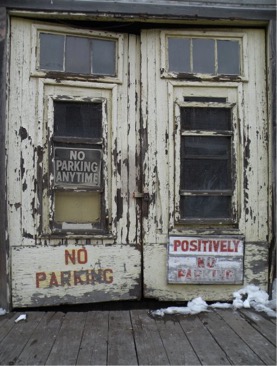 When I fist took this photograph on a cold February day in Portland, I had no idea what it was going to do for me.
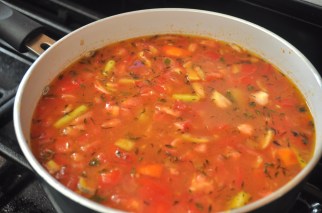 Story Soup
 I use this metaphor when I tell my students why they need textbooks. The books provide recipes for essays. While the students are still developing as writers, they need to follow the recipes to practice engaging introductions, clear thesis statements and easy to follow patterns of organization. Once they get the basics down, they can change up the ingredients and proportions to tailor their essays to fit their specific needs or assignments.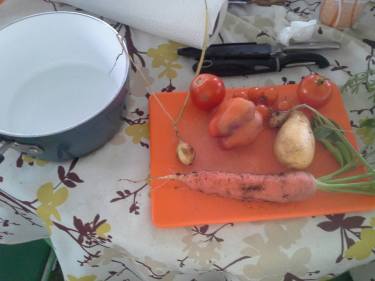
 Step 4: Coat the vegetables with approximately one teaspoon of Thyme and Basil. If you used larger veggies, you might want to add a little more. Allow the vegetables to cook until they become tender. The carrots and celery take longer than the other veggies, so I suggest chopping and adding those first.
 Step 9: Allow it all to simmer for at least one hour, stirring occasionally. The longer you let it cook, the better its tastes. I am often hungry and impatient, so I eat a bowl after an hour but let it cook for two or three more. The next day, when I have seconds, the taste has significantly improved.
 Sara Codair